
WRC Success (1999-2003)
Following the initial success of the car Ford tried to boost their marketing strategy by building a rally version. WRC at this stage had a much bigger media impact than in previous decades and it was an opportunity not to be missed. The results of this transformed a very new design into an established enthusiast choice.
Ford contracted M-Sport to design a WRC contender with an all-wheel drive system and acquired the services of established WRC drivers Colin McCrae and Carlos Sainz to drive it. Gunther Steiner led the development of the car, already well-known for his work in designing the Lancia HF Integrale and would later work in the Jaguar/Cosworth team in Formula One.
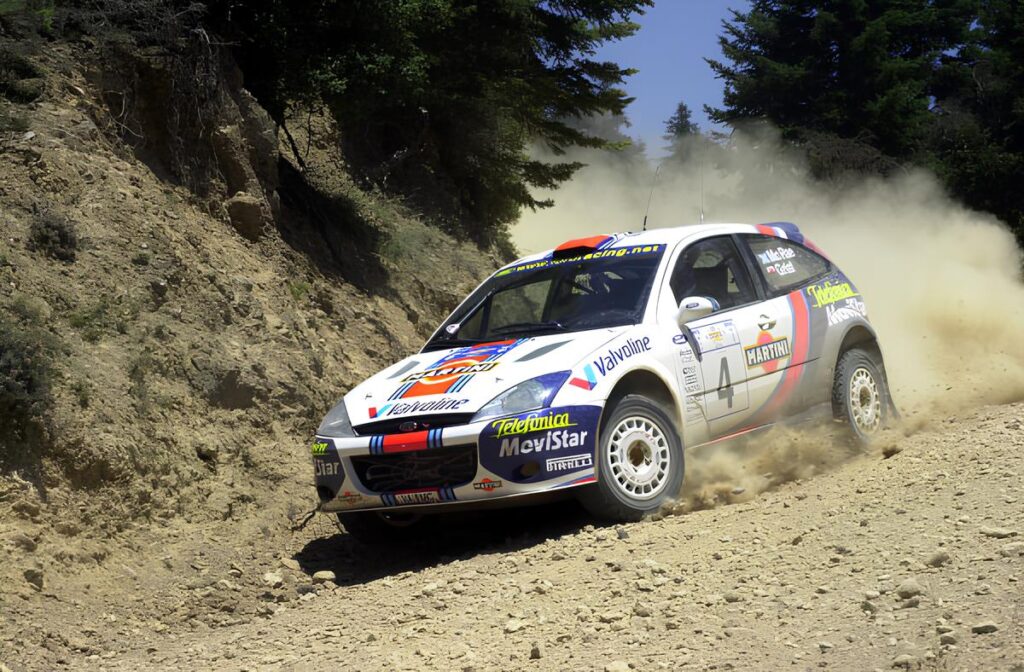
It was fully loaded to say the least; with an active front and centre differential, a six speed sequential gearbox and a turbocharged version of the Zetec 2.0-Litre engine. There were some interesting features, the engine was inclined 25 degrees to the rear and the turbocharger has been used previously on Escort Cosworth WRC cars. The exhaust system contains turbo anti-lag devices and is manufactured of heat resistant Inconel alloy. Many of the WRC engine, gearbox and suspension components were manufactured by L.M Gianetti, an Italian specialist. The gearbox was designed by British firm ‘Xtrac’ and mounted centrally underneath the car to maintain a 60-40 weight distribution.
The suspension was pretty close to a standard road-MK1, only requiring spring and damper changes, mainly having adjustable Reiger dampers with a small nitrogen tank mounted on each strut assembly.
After eleven months of development the Focus was ready for its WRC 1999 season and made an excellent debut at the Monte Carlo rally finishing third driven by Colin McRae who was then regarded as one of the best WRC drivers. There was also a second car driven by French driver Jean-Joseph which finished 11th. For a completely new developed car this was a resounding start. However due to an illegal water pump mounted separately off the engine the FIA later disqualified this entry. During the season Thomas Radstrom joined the team, a driver who enjoyed gravel and snow rallies.
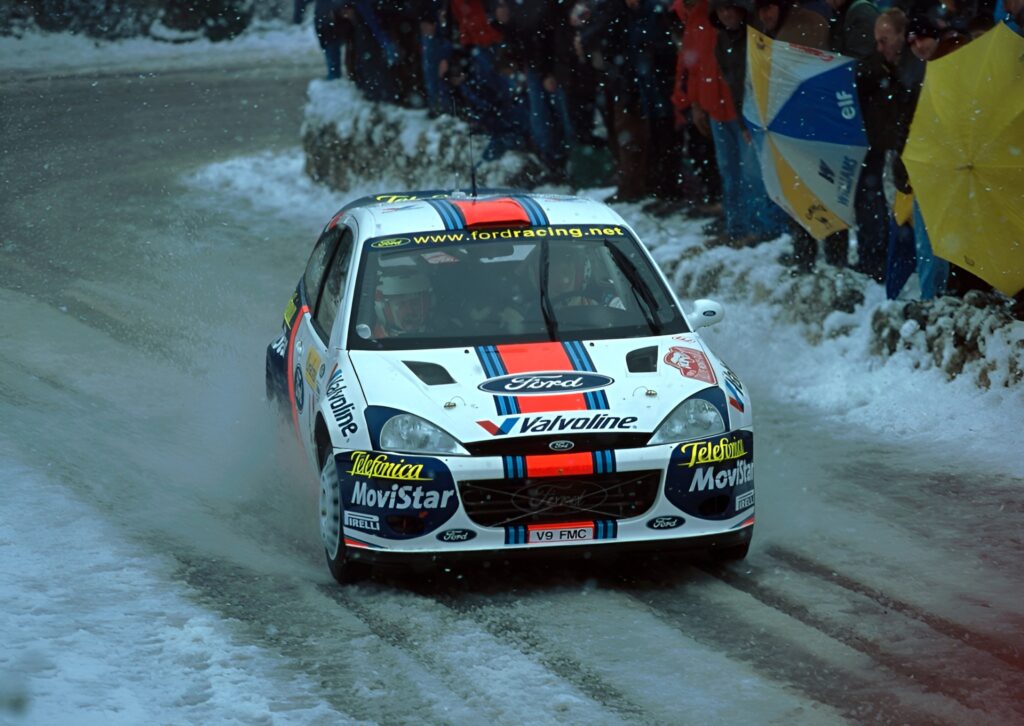
The biggest highlight was Thomas Radstrom beating Didier Aurol (in a Corolla WRC) overturning a deficit of a few seconds into eight seconds advantage through some heroic driving and lots of weight shedding of the car. Later that season Carlos Sainz joined the team for the oncoming 2000 season. Colin McRae was at the time extremely unhappy with the car’s reliability which hampered the ability to consistently build momentum towards a championship victory. The car of that season introduced a new turbocharger, improved aerodynamics with a smaller rear wing spoiler, clutch repositioning and some engine changes.
In total over five years the car won 16 rallies, 9 with Colin McRae who left the team in 2003, 5 with Markko Martin who replaced McRae and 2 with Carlos Sainz. The Focus WRC never won a WRC title but its impact has never been forgotten and influenced the design of road-destined RS!
European Facelift
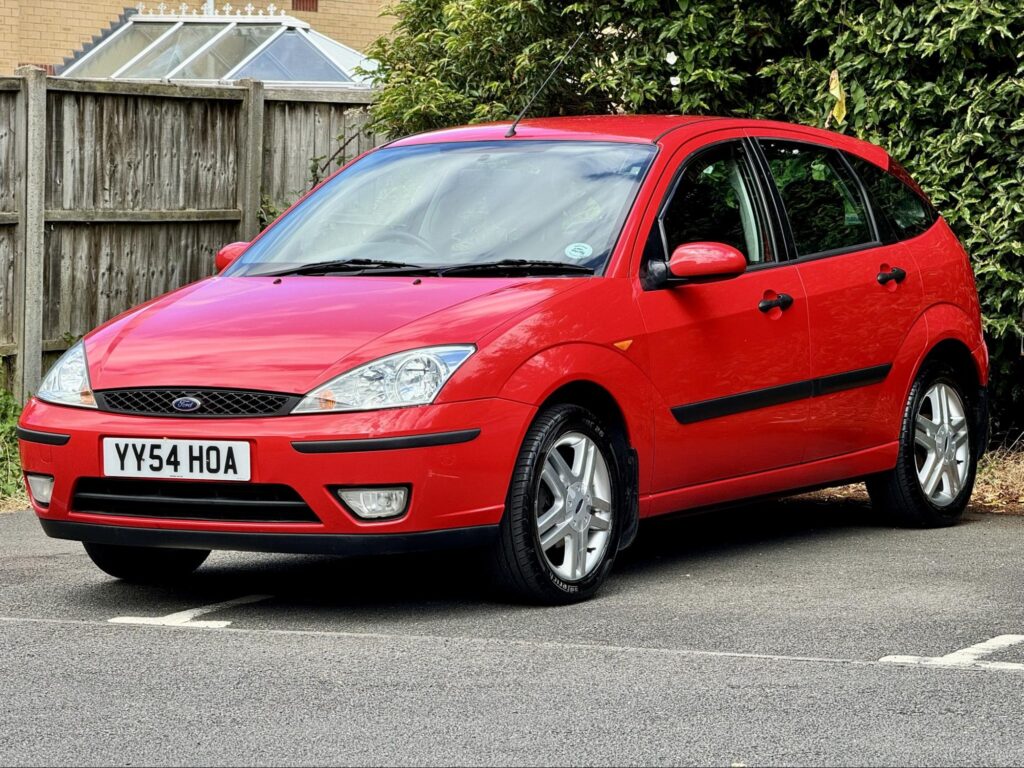
In October 2001, the model underwent a mid-life facelift that introduced a series of noticeable cosmetic updates. The headlights were redesigned to include integrated front indicators, plastic sill covers were removed, and new mouldings were added to the front and rear bumpers. Alongside these visual changes, Ford introduced the much-improved TDCi common-rail diesel engine. This period also marked a phase of cost-cutting for the model, with certain components quietly downgraded in quality—changes that were often imperceptible to most buyers. Despite these measures, the car remained a strong contender in its class, retaining its popularity and competitive edge over rival models.
The ST170
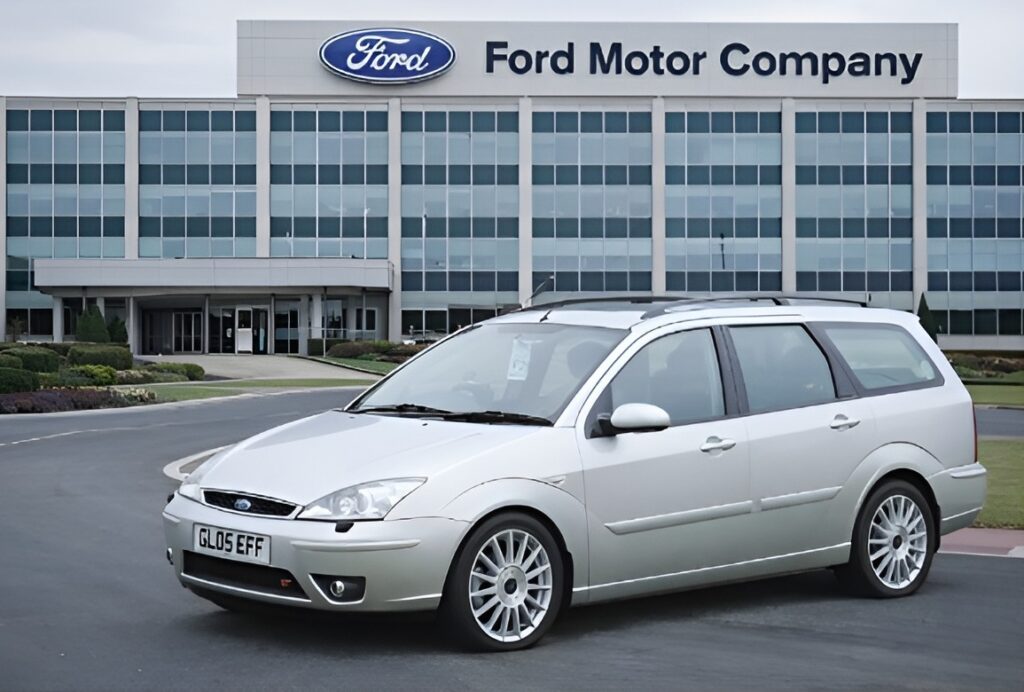
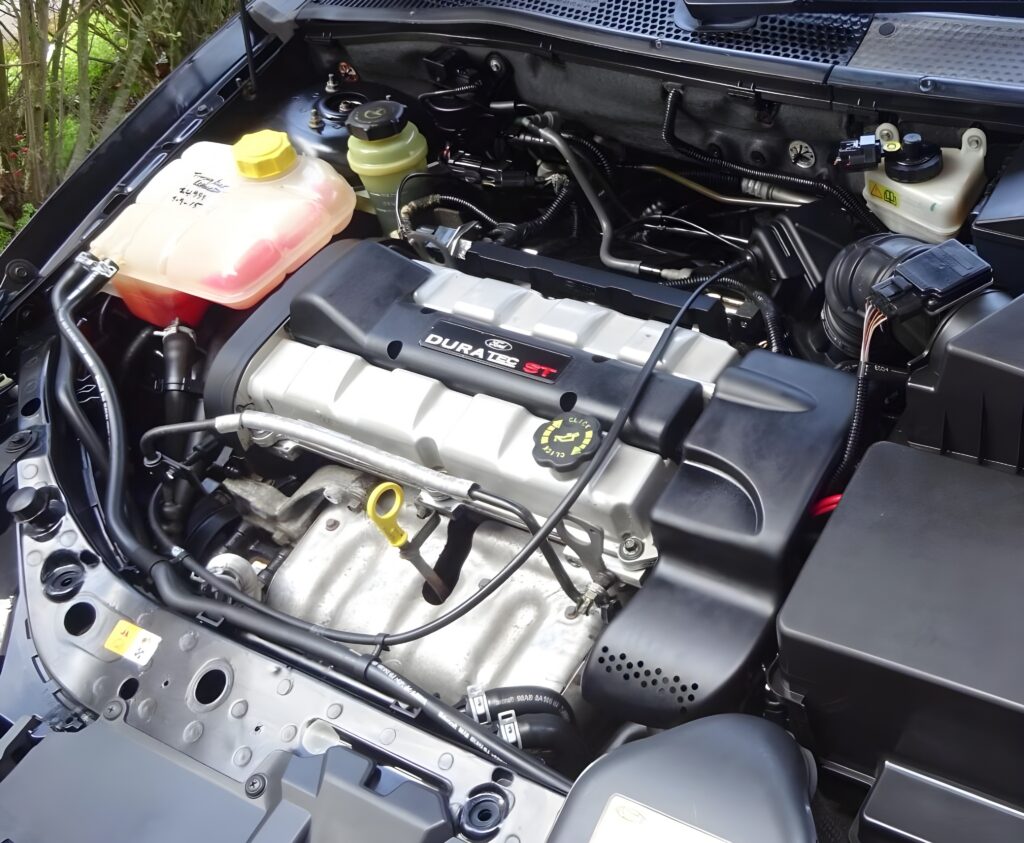
Ford always planned for a hot-hatch version of the Focus which could take advantage of the dynamically capable chassis, sharp styling and appeal to the more spirited driver. Named “ST170” for it’s total bhp, it was equipped with lowered suspension and aggressive-styling cues, this was a joint engineering exercise with Ford in North America (SVT). The project was eventually launched in March 2002 in 3-door, 5-door and estate variants. It’s re-worked engine was named ‘Duratec-ST’.
The Duratec-ST was, in essence, a Zetec engine in disguise, heavily reworked to deliver significantly enhanced performance. At its core was a Cosworth-designed cylinder head, featuring larger inlet valves, stiffer valve springs, and Variable Valve Timing (VVT). Forged pistons added durability, while a dual-stage inlet manifold and a free-flowing exhaust system allowed the engine to breathe more efficiently. These upgrades boosted output from the standard 2.0-litre’s 130 bhp to an impressive 171 bhp, with torque increased to 195 Nm. To handle this extra performance, power was transmitted through a specially selected Getrag 285 six-speed manual transmission, chosen specifically for its compatibility with the enhanced drivetrain.
In terms of styling, the ST170 stood apart with its distinctive 17-inch alloy wheels, which accommodated larger front and rear disc brakes for improved stopping power. The suspension was specifically engineered to handle wider 215/45 tyres, enhancing both traction during acceleration and braking stability. Compared to the standard models, the suspension was lower and stiffer, delivering a totally focused driving experience. Inside, the changes were more subtle. While the interior layout remained largely familiar, the ST170 featured half-leather sport seats (with optional full-leather Recaro seats), aluminium-style pedals, and electroluminescent instrument dials, all of which subtly reinforced its performance-oriented character.
Many of the competitors managed more power but the ST170 was dynamically one of the best in its class. Ford tried to keep it smothered so it didn’t infringe on the incoming RS, not brutally fast but extremely pleasurable by the standards of motoring today.
Return Of The RS
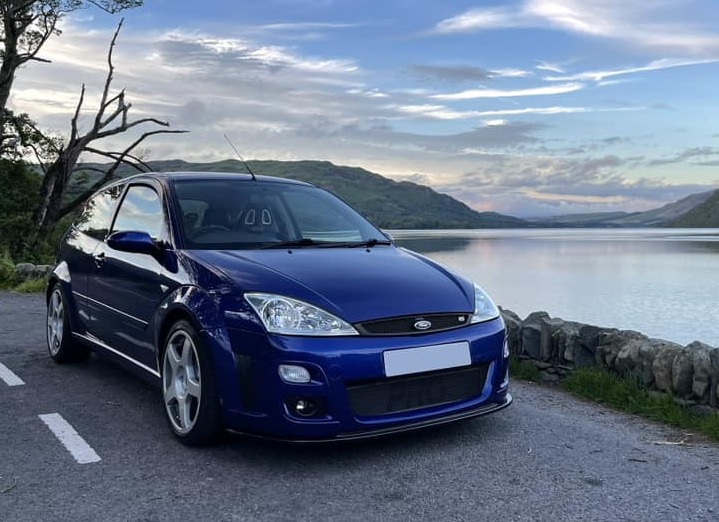
During the same period when the Focus WRC car was introduced, a special division of Ford turned their attention to bringing back the RS name which had been dormant for many years, in the guise of a Focus RS. Initially developed as the “Racing Focus” (after the Racing Puma) the car was revealed as the new RS at the 2001 Geneva motor show. It used the 3-door shell (painted in Imperial Blue only) with blistered arches and its lowered stance made it look far apart from the everyday models.
The car was thoroughly re-engineered with around 70% of the components being completely new or redesigned. The 2.0L ‘Duratec-RS’ was a heavily reworked Zetec engine which developed around 212bhp featuring a Garret turbocharger, WRC-Style pistons, forged conrods, modified exhaust manifold with an enlarged exhaust bore, a water-air-intercooler and unique air intake system. A revised engine management system was utilised along with fuel injectors designed for a higher flow. It was good for 143 mph and a 0-60mph time of 5.9sec, not a speed monster by today’s standards but enough for the front-wheel drive platform to handle the performance. This was achieved partly by using a Quaife differential, which has a torque-biasing feature where torque was supplied to whichever wheel has the least traction to prevent wheelspin.
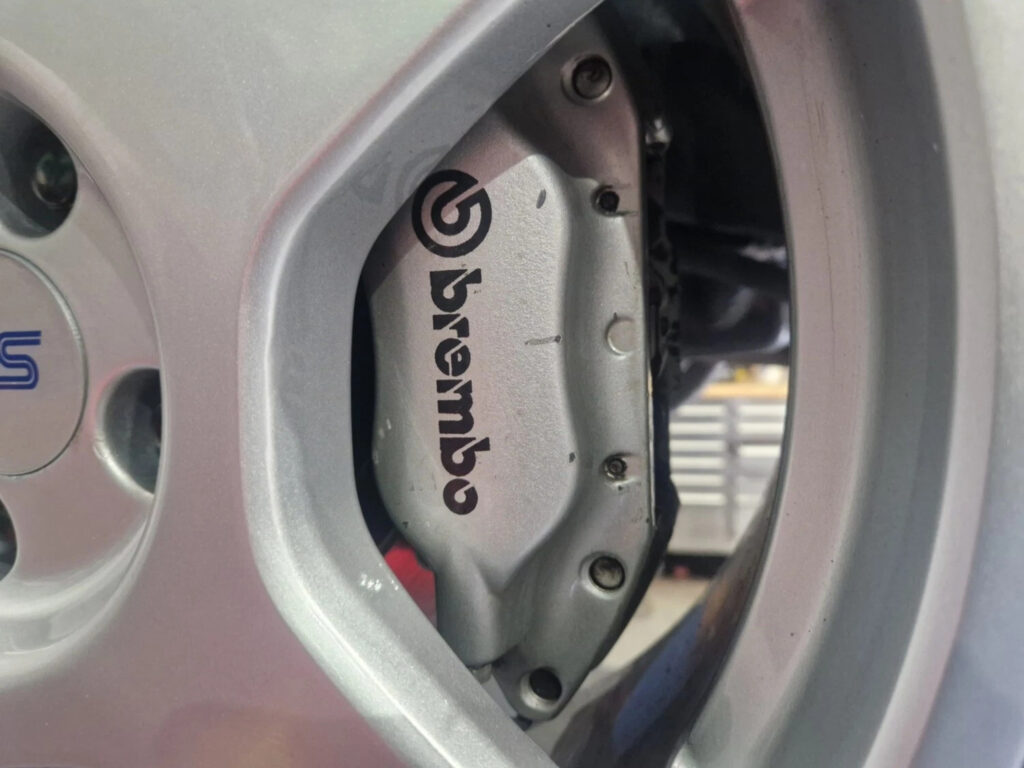
The suspension was heavily revised, Sachs dampers were fitted with a thicker 18mm front anti-roll bar. The suspension was generally stiffened and lowered by 25mm with increased negative camber. The steering rack was also revised. Braking power was supplied by 4-pot calipers and Brembo 324mm ventilated discs up front. The brakes are covered by 18″ OZ Racing light-alloy wheels.
Overall, the bodywork remained largely familiar in both interior and exterior design, but with a number of distinctive, performance-focused elements. Unlike the purpose-built WRC rally car, certain components on the road-going version had to be mass-produced. As such, wheel arch extensions and wings were constructed from metal, while the bumpers were made from reinforced polypropylene for durability and cost-effectiveness. Side sills and a rear spoiler further enhanced the car’s aggressive stance and visual impact. Inside, the performance theme continued.
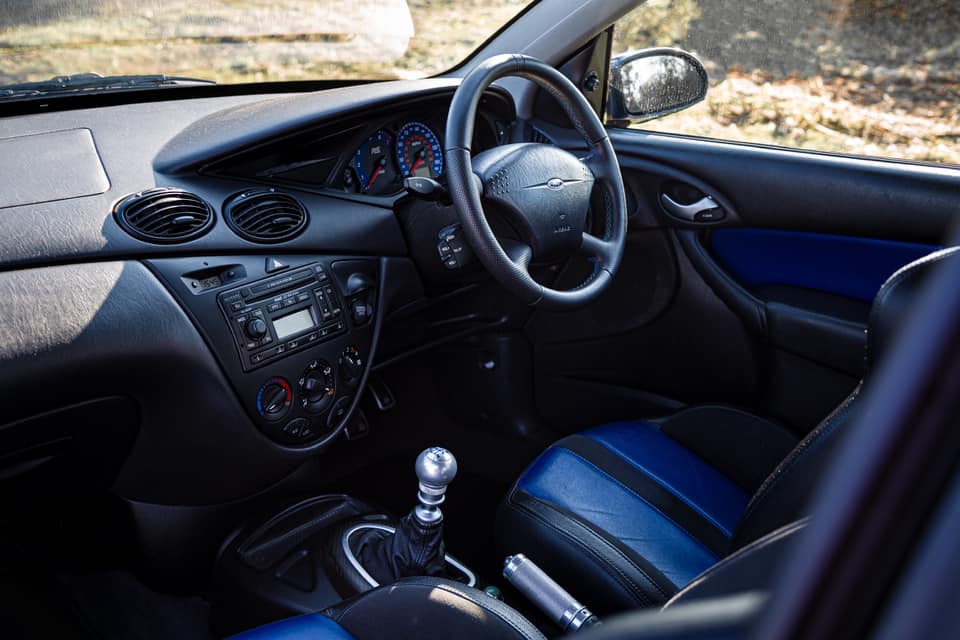
Interior-wise, the steering wheel featured a unique blue and black leather trim, complemented by aluminium pedals and handbrake handle. The instrument cluster was customised with blue accents, giving the cabin a more distinctive, motorsport-inspired feel. Sparco bucket seats provided excellent lateral support, and a separate starter button mounted on the centre console added to the car’s rally-bred character.
In total, Ford produced exactly 4,501 MK1 RS examples at its Saarlouis plant by a hand-picked engineering team between September 2002 and December 2003. Exactly 2,147 of those were registered in the UK.
Today it is widely recognised as the car that brought the RS name successfully back into the fold. Presenting as the ultimate performance version of the MK1, whilst taking the ‘New-Edge’ design to a new degree of sharpness.
European Production Finishes
During 2003 there was minor trim and electrical changes but the Focus was mostly unchanged from the facelift in 2001. Many special editions were released across Europe to spruce up interest. Throughout 2004, model and bodystyle choices were gradually slimmed down with production finishing at Saarlouis in early September 2004, the line being used for the incoming MK2 production. This left only the Valencia plant to continue producing 5-door and Saloon models until December 23rd! This we believe is the final production day of the MK1 in Europe. These models were all registered by May 2005 with some odd exceptions.
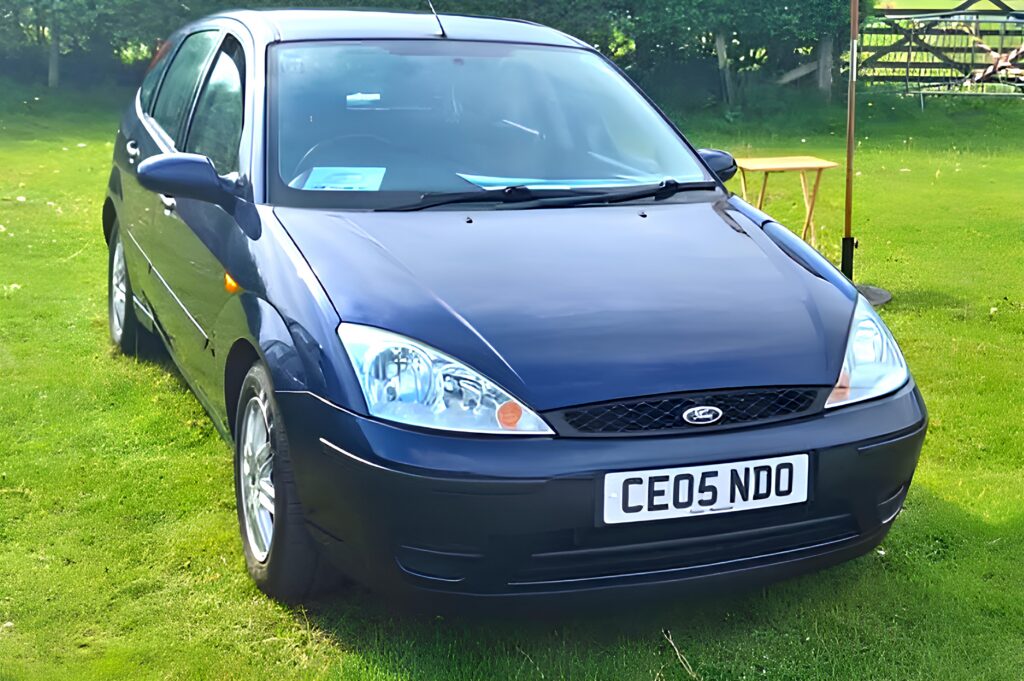
This ended a hugely successful production run, selling in countless European countries successfully. This included France; Germany, Switzerland, Spain, Portugal, Italy, Netherlands, Belgium, Romania and a few others listed below. Some countries like Poland and Lithuania never had a dealer network but examples were quickly imported from Germany.